Find out if your strategy can survive contact with your actual team
Most strategy tools help you write the plan. This one checks whether the plan can run — against the people you have, the skills they can prove, the capacity that is already spoken for, and the AI work you have actually set up.
1. Start from a business problem, not an empty box
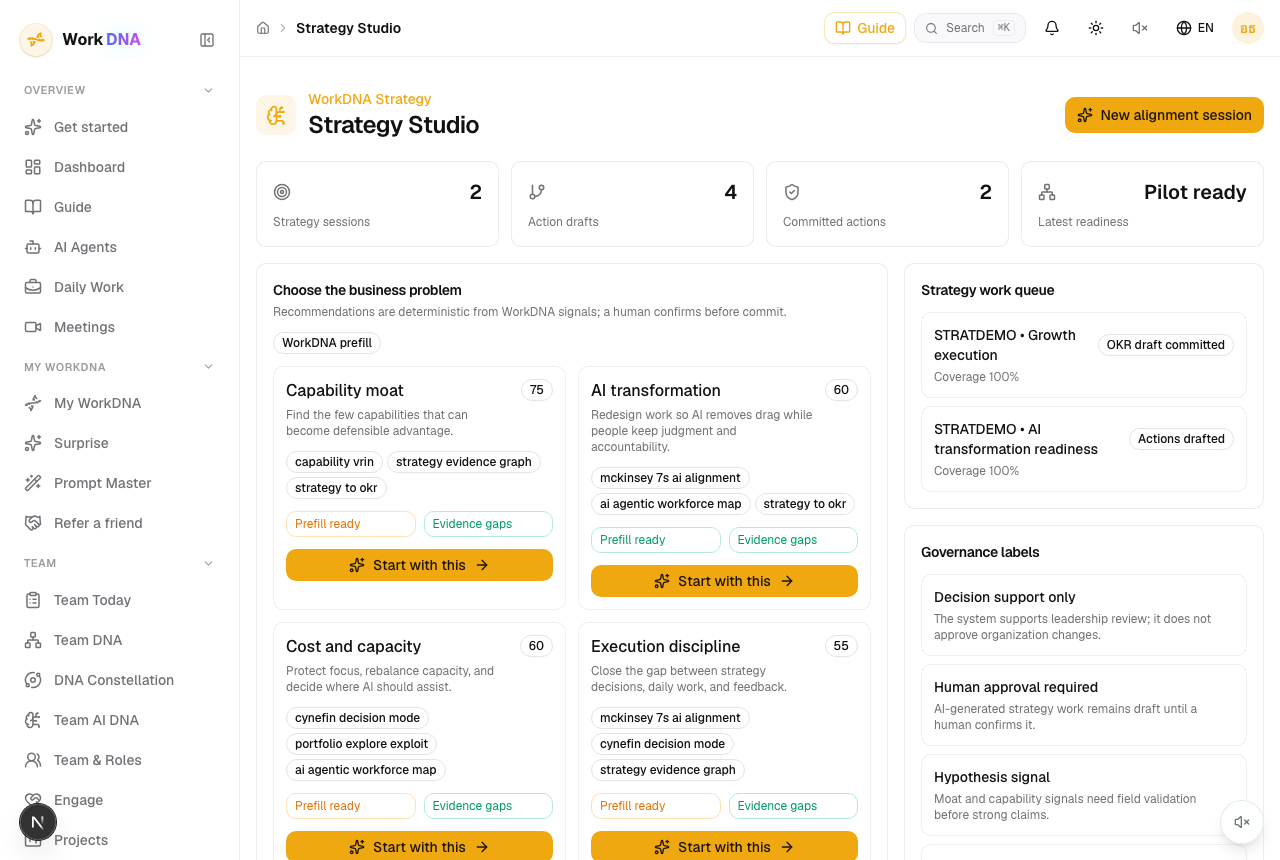
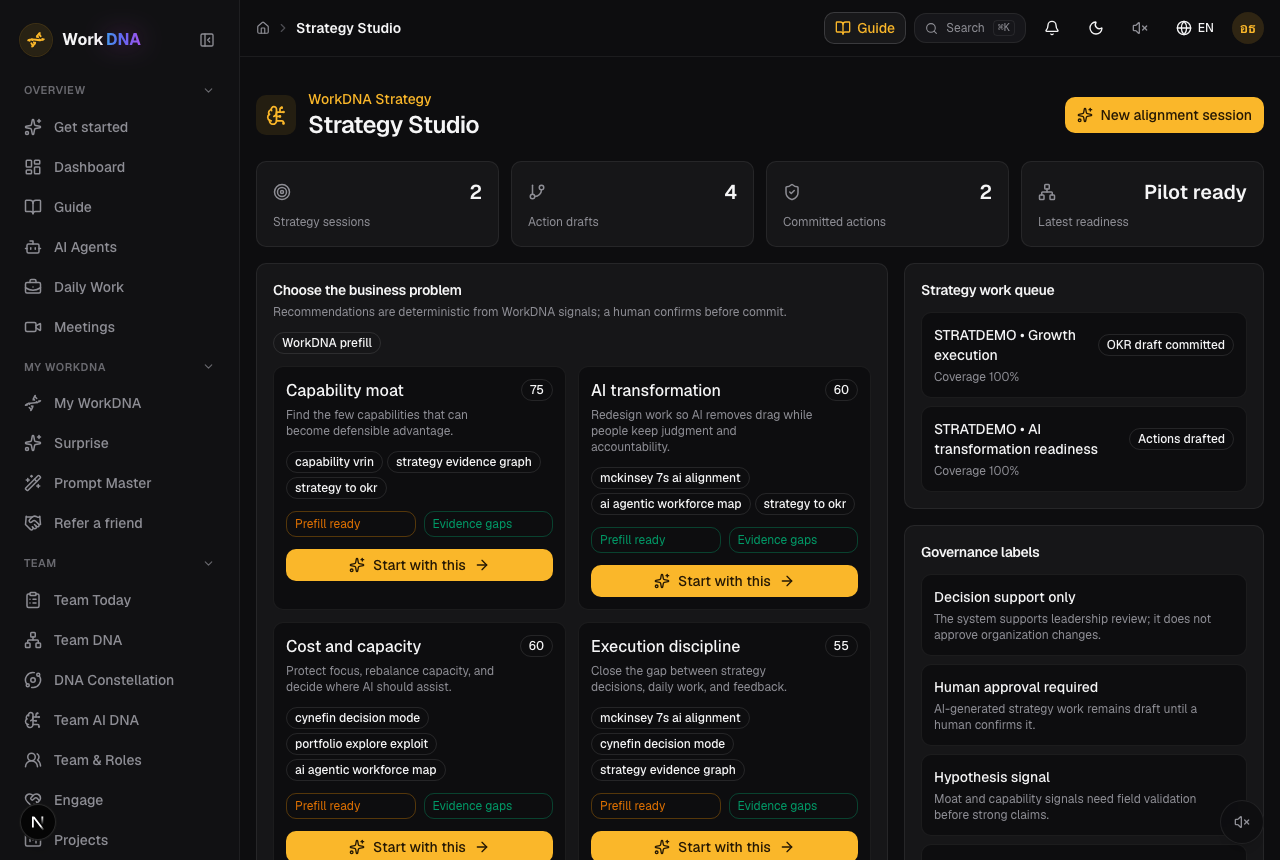
Open Strategy Studio and you are not asked to describe your strategy. You pick the problem you already have — capability moat, AI transformation, cost and capacity, execution discipline — and the system suggests which strategy lenses fit it.
Each card already knows something about you. "Prefill ready" means WorkDNA can fill part of it from your own data. "Evidence gaps" means it will have to ask you for the rest, and it tells you that up front instead of quietly guessing.
2. It goes and finds the evidence itself
Press one button and WorkDNA reads what it already has across eight dimensions: your OKRs, your org structure, committed capacity and real logged hours, your skill matrix and which skills are actually verified, your operating cadence, your headcount and projects, and your AI agent setup.
You get a coverage figure and a confidence level per dimension. Where it has nothing, it says so — that is the point of the number, not decoration. A dimension marked Medium or missing is a request for input, not a failure.
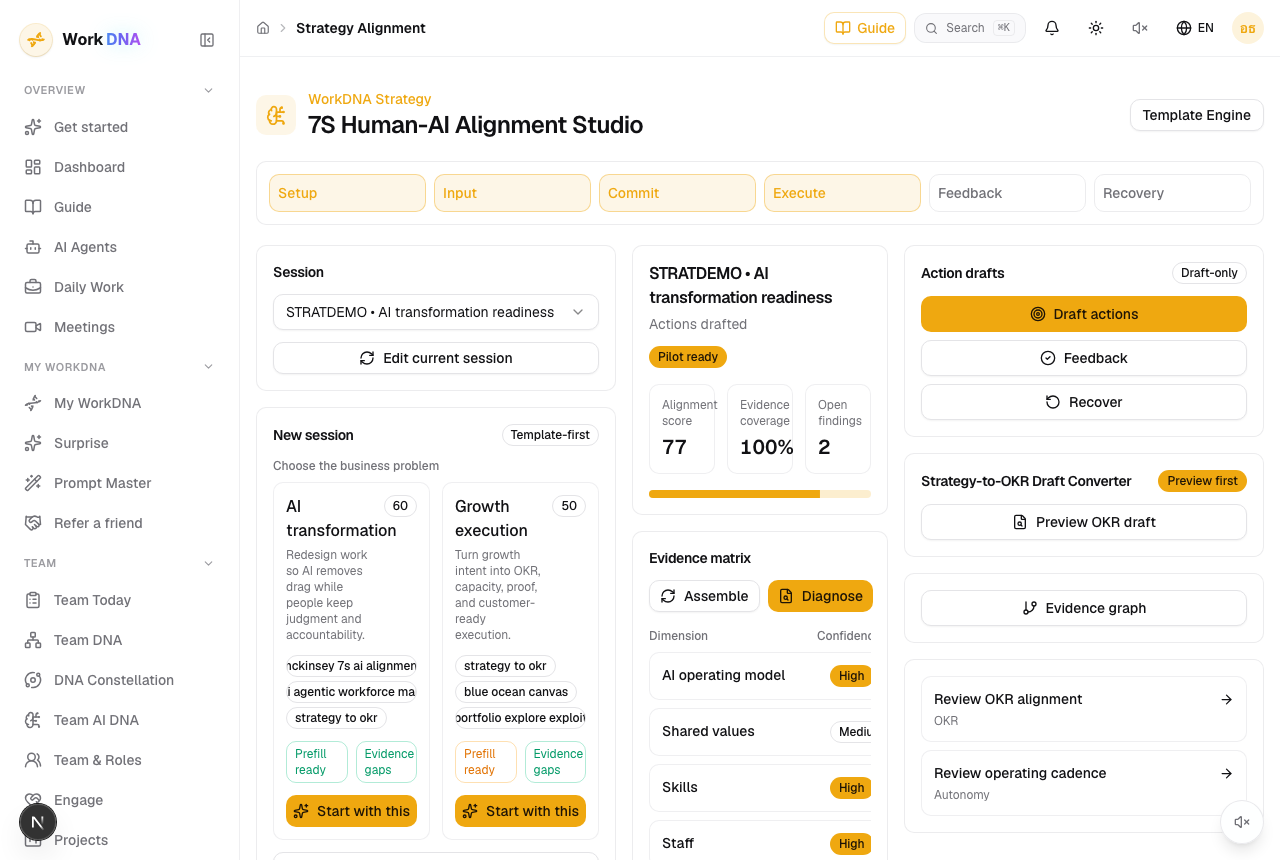
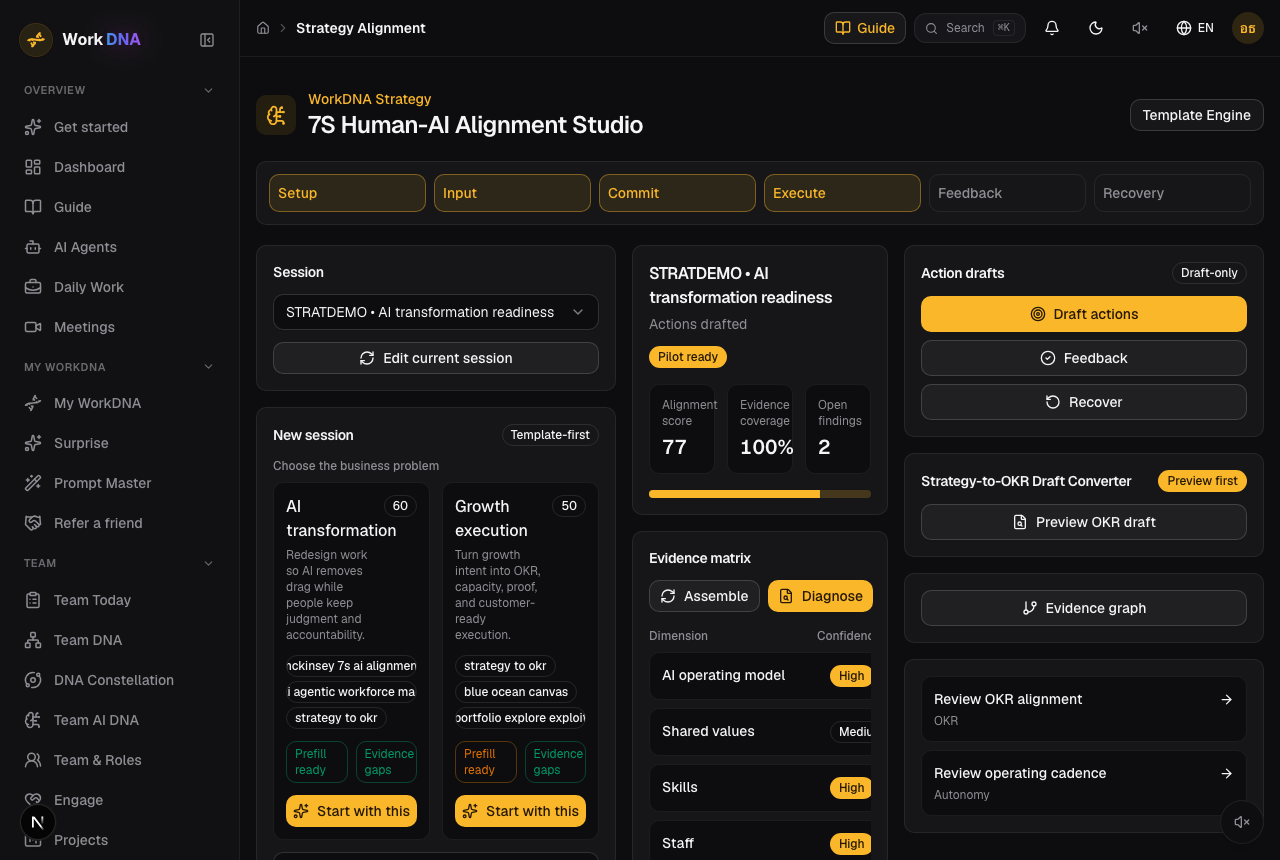
What the number is, and what it is notThe alignment score is a rough summary of the dimensions below it. It is not a grade for your company and it is never a score for a person.Read the evidence coverage next to it first. A score computed from thin evidence is a thin score, and the studio shows you both numbers side by side precisely so you can tell the difference.
3. See exactly what would change — before it changes
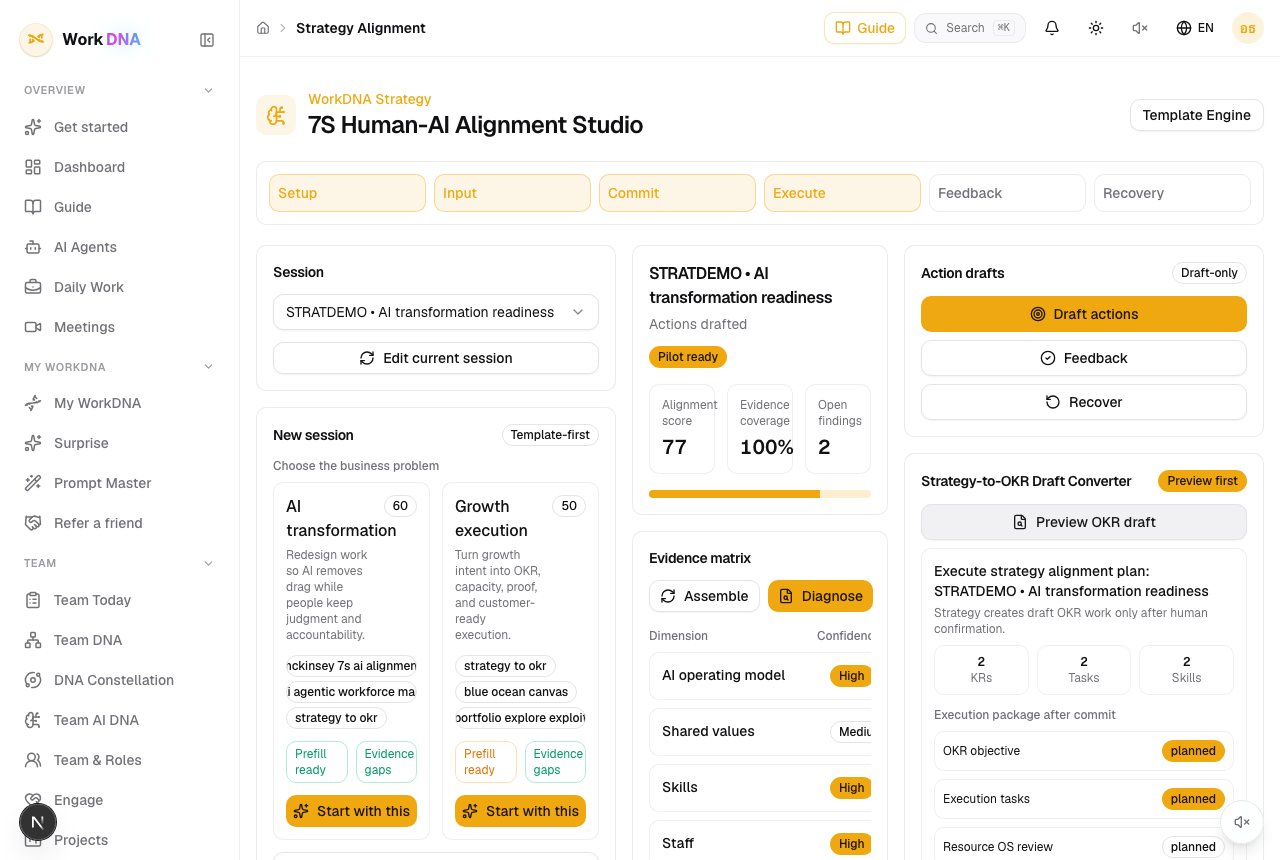
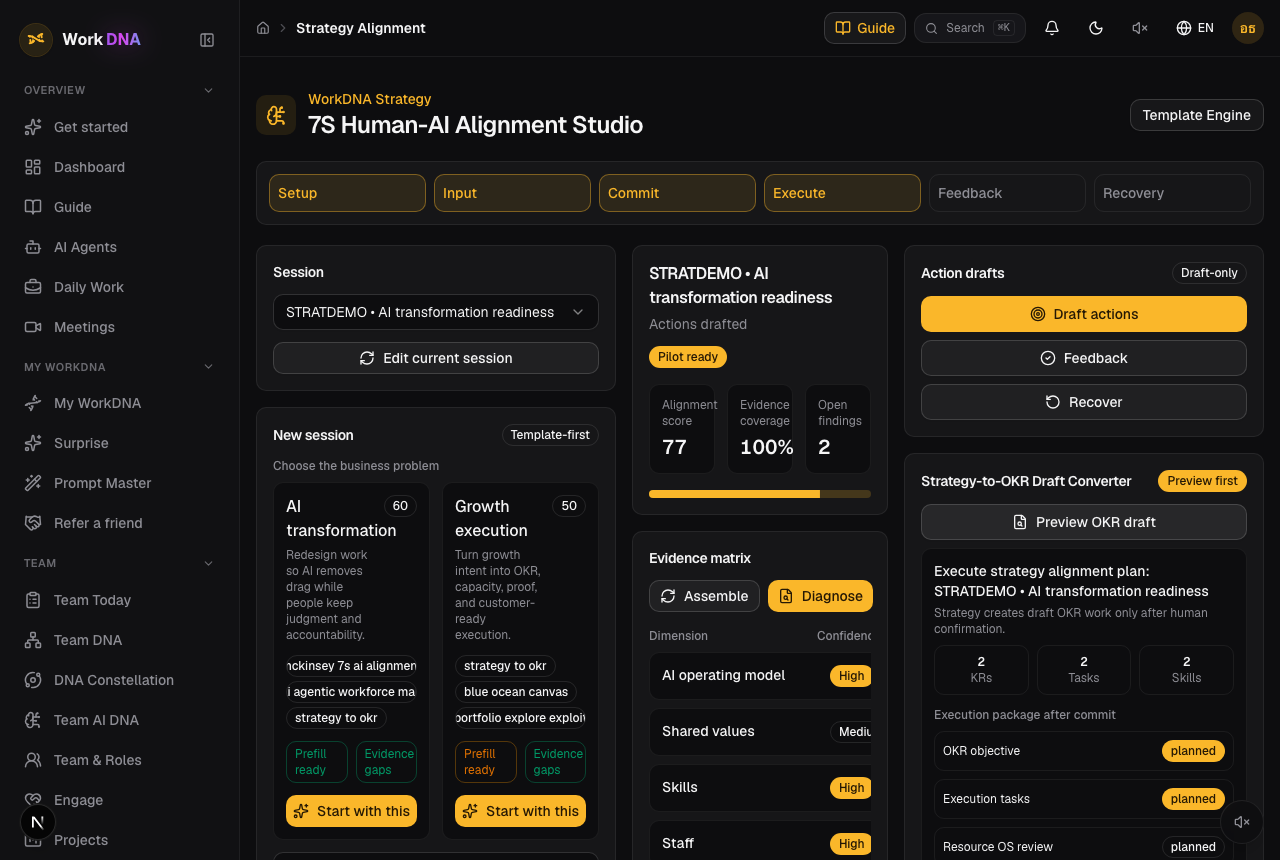
When you turn findings into action, nothing is written yet. Everything arrives as a draft, marked draft-only, and the converter shows you the whole package first: how many key results, how many tasks, which skills, and which other parts of WorkDNA would be touched — Resource OS, training, daily work.
Every line says "planned". You read the list, then you decide. If you never press confirm, nothing anywhere in WorkDNA moves.
4. Come back later and check whether it actually moved
After you confirm, the draft becomes real work: an OKR objective with key results and tasks, a training plan where skills were the gap, a resource review where capacity was.
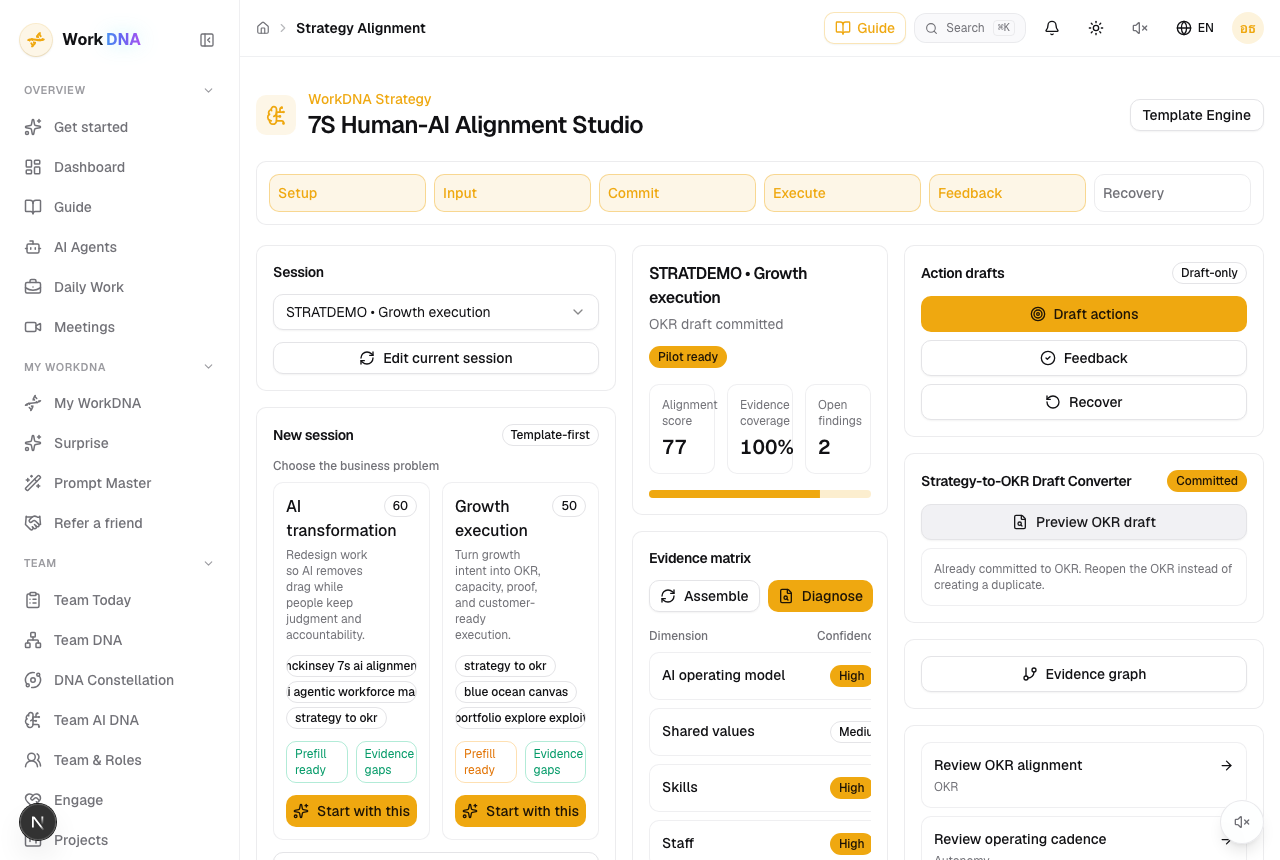
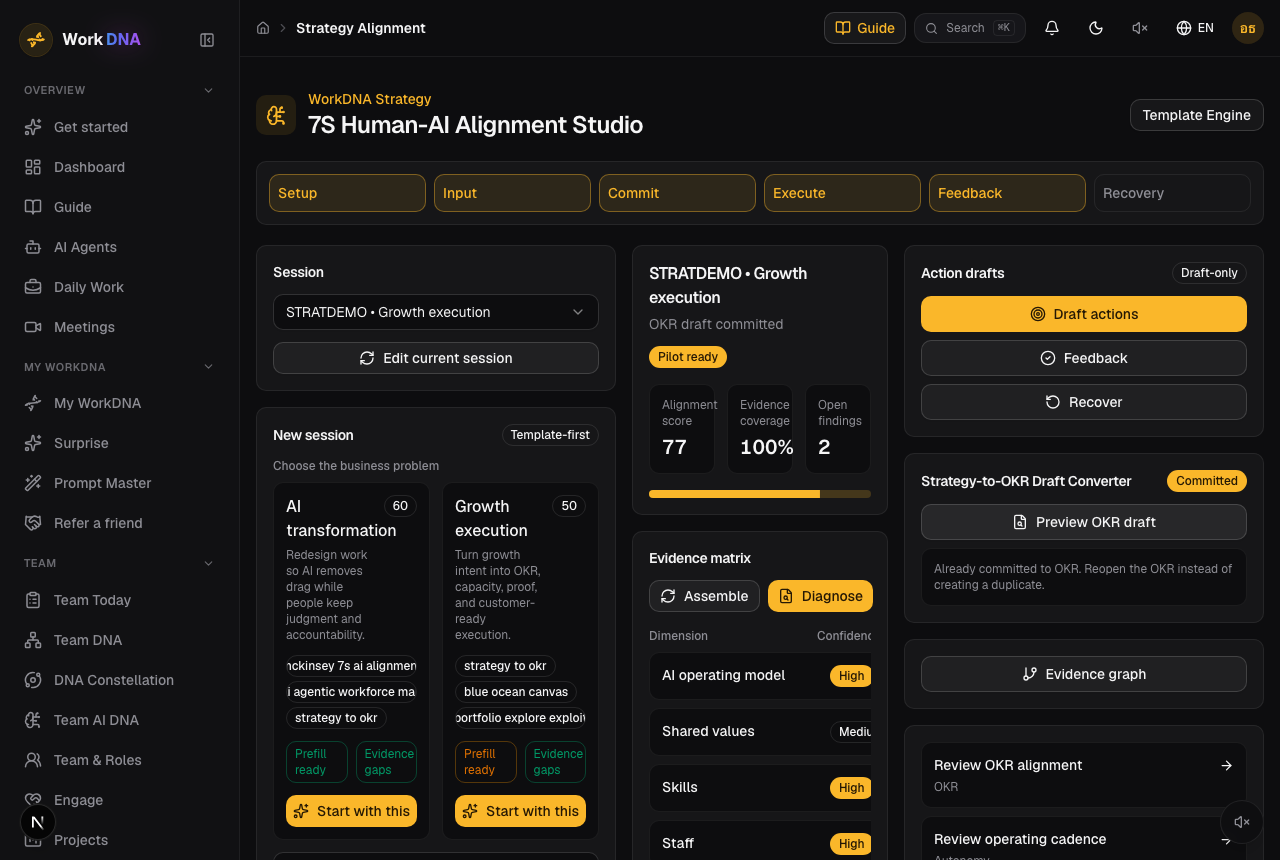
The next time you open the session it reads your actual work back — hours logged, OKR progress, tasks finished, training done — and links each one back to the finding that caused it. That is the evidence graph: it shows what connects, and it shows what is still missing rather than filling the hole with a guess.
If something is wrong, you can undo it
- Recover reopens the session so you can correct the input and run it again.
- Reject a draft action and nothing downstream is created.
- Findings you disagree with can be dismissed — the diagnosis is a starting point for the conversation, not a verdict.
- Every state-changing step is recorded, so you can see who confirmed what and when.
What this will not do for youIt will not decide your strategy. It checks whether the strategy you chose can be executed by the organisation you have today, and turns the gaps into work you approve.It also cannot yet tell you that following it improves results. That claim needs a real pilot over real months, and until that exists this is decision support — a well-evidenced second opinion, not proof.